



Why Choosing the Right Fastener Matters for Your Project
Stainless steel screws are corrosion-resistant fasteners made from steel alloys containing at least 10.5% chromium, designed for long-lasting performance in both interior and exterior applications. Here's what you need to know when choosing fasteners:
Quick Guide to Stainless Steel Screws:
- For general exterior use: Choose 18-8 (304/A2) grade screws for external cladding and general outdoor projects
- For coastal or marine environments: Use 316 (A4) grade screws with added molybdenum for superior saltwater resistance
- For high-strength applications: Consider 410 grade for self-drilling into metal or hardwood
- Always prioritise: Corrosion resistance over initial cost to avoid rust streaks and premature failure
There was a time when periodic repair of mechanical and outdoor components was taken for granted. Today, with labour costs at record levels and going up, greater consideration at the design level is being given to the reduction or even elimination of maintenance. This is especially true for your cladding project, where the wrong fastener choice can lead to unsightly rust streaks, structural weakness, and costly repairs down the track.
The difference between a pristine exterior that lasts decades and one that shows its age in months often comes down to something as small as the screws you choose. While it might be tempting to save a few dollars on zinc-plated or galvanised fasteners, that decision can cost you significantly more when you're forced to replace failing screws or repair rust damage to your beautiful new cladding. The global stainless steel screws market was valued at USD 1.2 billion in 2022 and is projected to reach USD 1.8 billion by 2030, reflecting the growing recognition of their long-term value.
Whether you're installing WPC cladding, aluminium panels, or cement sheets, the fasteners you select are just as important as the cladding material itself. Different grades of stainless steel offer different levels of protection, and understanding which grade suits your specific environment and application is crucial for a successful outcome.
I'm James Lawrence, and over my 15 years in Melbourne's construction sector, I've seen countless projects compromised by poor fastener selection, which is why choosing the right stainless steel screws for your cladding is always part of our guidance at Clads Australia. My experience across B2B sales and project coordination has taught me that the details matter, especially when it comes to the longevity of your investment.
Why Are Stainless Steel Screws a Superior Choice?
When creating architectural aesthetics and ensuring project longevity, the choice of fastener is paramount. Stainless steel screws are a commitment to durability and quality craftsmanship, with clear advantages that make them an indispensable choice for builders, architects, and homeowners.
The primary benefit is exceptional corrosion resistance. Unlike coated screws, stainless steel inherently resists rust, especially in the Australian climate. This means a longer lifespan for the fastener and cladding system, reducing maintenance and protecting your investment.
Furthermore, stainless steel screws offer superior strength. While zinc-plated screws may seem adequate, they often fail in demanding applications. Stainless steel provides the robust hold and structural integrity needed for high-performance cladding, ensuring panels remain secure for years. This strength is critical for ensuring your cladding delivers impact and longevity.
Beyond function, there's the aesthetic appeal. No one wants to see unsightly rust streaks bleeding down their beautiful new exterior cladding. Stainless steel screws maintain their pristine appearance, preserving the visual integrity of your design. They offer reliable weather and water resistance, making them ideal for exterior applications. This combination of resilience and elegance makes them a superior choice for our high-quality cladding accessories.
The Problem with Plated Screws
To save on initial costs, many opt for plated screws, such as those with zinc plating or galvanised coatings. While these coatings offer a temporary barrier against corrosion, they are fundamentally flawed for long-term exterior use, especially in Australia's diverse environments.
The main issue is wear and tear. During installation or through the expansion and contraction of materials, these coatings can be scratched. Once the protective layer is compromised, the underlying carbon steel is exposed to moisture, leading to rapid rusting. This is not just an aesthetic problem; rust weakens the screw, compromises structural integrity, and stains surrounding materials. Such fasteners are unsuitable for harsh environments, where the cost of removal and replacement often far outweighs the initial savings.
The Long-Term Value of Stainless Steel
Choosing stainless steel screws is an investment in your project's longevity and integrity. While the upfront cost is slightly higher than plated alternatives, the long-term value is undeniable. Consider the future expense of removing rusty fasteners and repairing rust-stained cladding. These costs, coupled with labour, quickly eclipse any initial savings. By selecting stainless steel from the outset, you significantly reduce future maintenance costs. This is why we advocate for quality fasteners for our high-quality external cladding solutions.
Using stainless steel fasteners means your joints remain robust and easily disassembled if maintenance is ever required, preventing the frustrating scenario of seized, corroded fasteners. This proactive approach ensures your project stands the test of time, reflecting Clads Australia's commitment to creating architectural aesthetics that are built to last.
Decoding the Grades: A Guide to Stainless Steel Types
Just as you would select the right tool for a specific task, the same logic applies to stainless steel screws. Not all stainless steel is equal, and understanding the grades is essential for a long-lasting cladding project in Australia's diverse climate.
The secret is in the chemistry. Varying amounts of chromium, nickel, and molybdenum determine a screw's corrosion resistance, strength, and workability. Changing the ingredients changes the outcome.
Stainless steels fall into two main families: austenitic and martensitic. Austenitic grades (304, 316) offer excellent corrosion resistance, while martensitic grades (410) can be heat-treated for exceptional strength but have less rust protection. Choosing the right family and grade for your project prevents future problems.
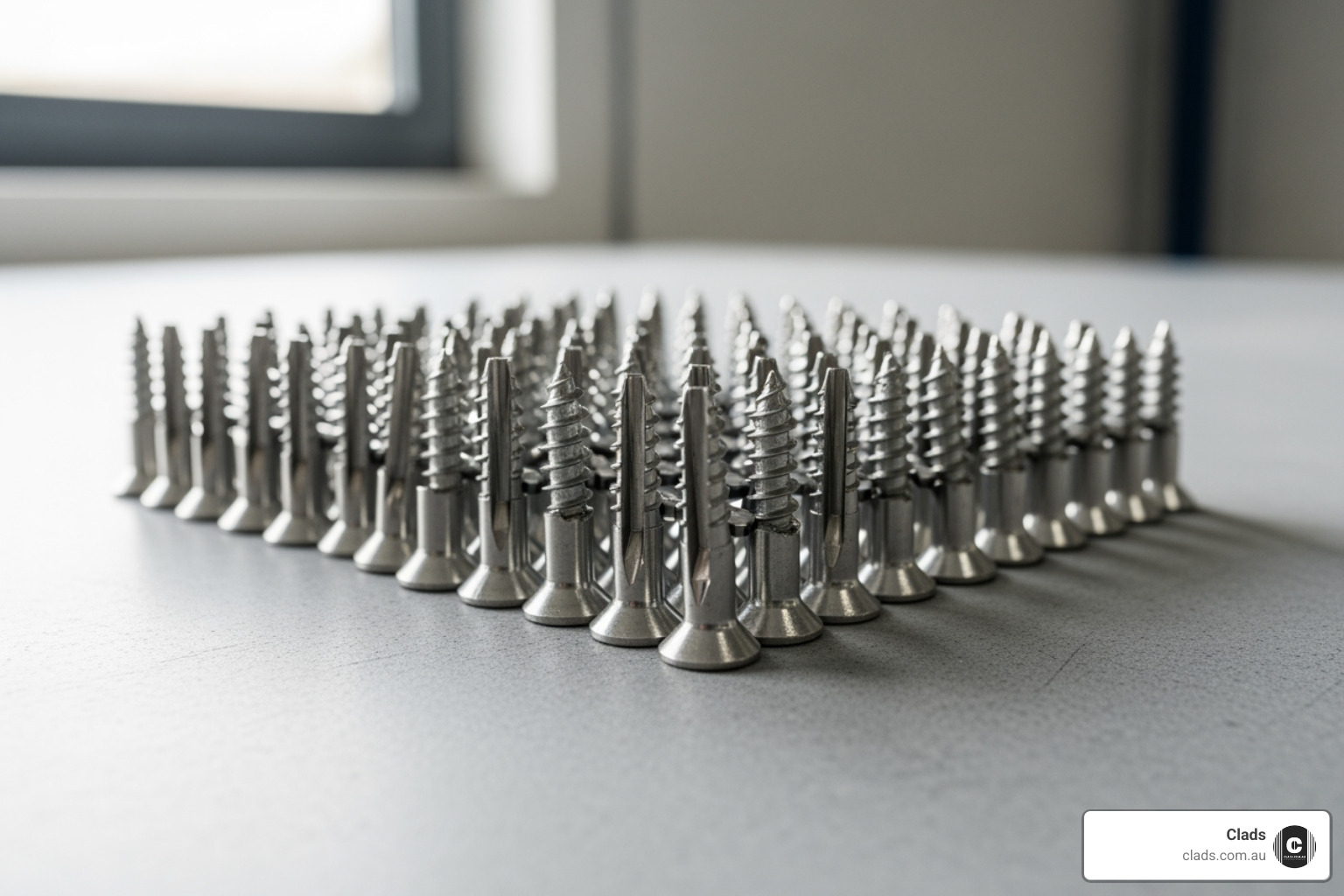
18-8 / 304 Stainless Steel: The All-Rounder
If you're looking for a reliable workhorse for general exterior projects, 18-8 stainless steel screws are likely your answer. Also known as Type 304 or A2 grade, this is the most common stainless steel fastener for outdoor construction.
The name "18-8" refers to its composition: approximately 18% chromium and 8% nickel. This combination delivers good corrosion resistance that's perfect for most outdoor applications around Melbourne and regional Victoria. Whether you're fastening external cladding or working on other outdoor projects in non-coastal areas like Sunshine, 304 screws will serve you well.
For practical purposes, the corrosion resistance of 302, 304, and 305 stainless steel is very similar, with differences mainly in manufacturing workability. Grade 18-8 (304) offers a great balance of strength, durability, and corrosion resistance for typical weather exposure.
316 Stainless Steel: The Marine Grade Champion
When your project faces Australia's coastal environment, you need a fastener that won't back down. Enter 316 stainless steel screws, often called A4 grade, the champion for marine and coastal applications.
What makes 316 special is molybdenum. This grade includes 2-3% molybdenum, which dramatically improves resistance to chlorides found in saltwater and salt spray.
If you're building near Victoria's coastline, working on a property exposed to salt spray, or installing exterior cladding projects in high-humidity areas, 316 is your go-to choice. The extra investment in marine-grade fasteners prevents the "weeping rust" that stains cladding and signals structural degradation, ensuring your project maintains its pristine appearance and integrity for decades.
410 Stainless Steel: The Hardened Performer
Sometimes you need serious strength, and that's where 410 stainless steel screws shine. Unlike 304 and 316 grades, 410 belongs to the martensitic family, meaning it can be heat-treated for impressive hardness and strength.
This makes 410 screws ideal for self-drilling into metal or hardwood without pre-drilling, as the hardness allows the screw to power through tough materials.
The trade-off with 410 is its lower corrosion resistance compared to 300-series grades. With less chromium and no nickel, 410 screws are best for dry, non-coastal environments where strength is the priority over corrosion risk. We don't recommend them for exposed external cladding where moisture is present.
Comparing Stainless Steel Screw Grades
To help you make the right choice, here's how the three main grades stack up:
| Grade | Common Name | Key Elements | Corrosion Resistance (General/Marine) | Strength | Primary Use |
|---|---|---|---|---|---|
| 304 | 18-8 / A2 | 18% Chromium, 8% Nickel | Good / Moderate | Moderate | General exterior, freshwater, everyday use |
| 316 | A4 | 18% Cr, 10% Ni, 2-3% Mo | Excellent / Superior | Moderate | Marine, coastal, saltwater, chemical environments |
| 410 | 12% Chromium | Fair / Poor | High (hardened) | Self-drilling into metal, hardwood (dry conditions) |
When investing in quality cladding accessories from Clads Australia, matching fasteners to the environment is key to longevity. Choose wisely, and your cladding will look as good in ten years as it does on day one.
How to Select the Perfect Stainless Steel Screws for Your Project
Choosing the right stainless steel screws for your cladding project requires a thoughtful approach. You must consider the application, environment, materials, and structural demands. At Clads Australia, we help architects, builders, and homeowners make informed choices that stand the test of time.
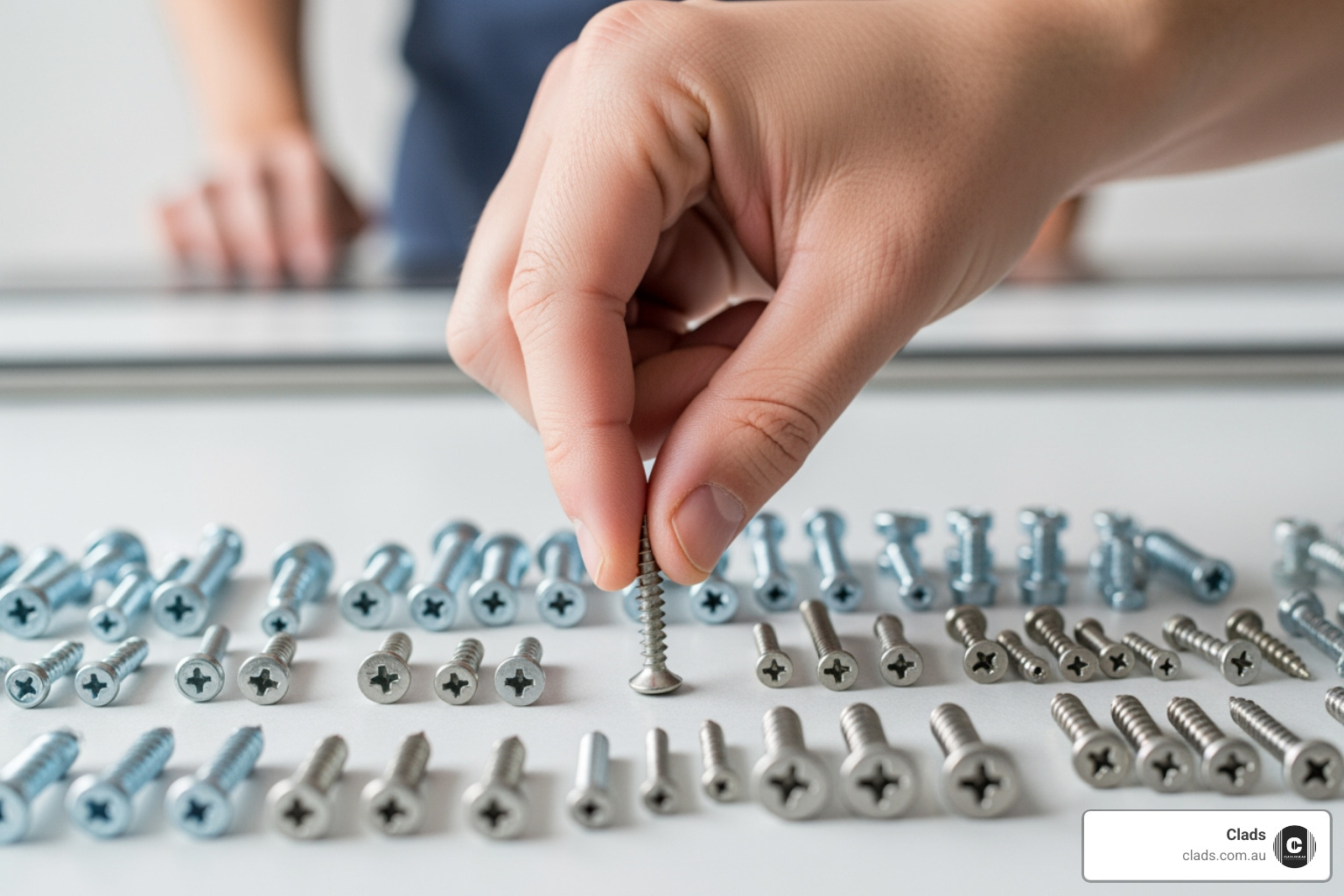
With over 500,000 standard fastener options available globally, the choice can seem overwhelming. However, understanding a few key principles simplifies the process. The assembled joint is a critical part of the overall design, and we're here to guide you.
Choosing the Right Grade of Stainless Steel Screws
The grade you select should be driven by your project's location and exposure. Think of it as matching the fastener's armour to the battle it will face.
For inland projects away from coastal salt spray, 18-8 (304/A2) grade stainless steel screws are ideal. They are the workhorses for exterior construction in typical Australian conditions, offering excellent corrosion resistance for external cladding in non-coastal regions like Sunshine, Victoria.
For marine or coastal environments, upgrading to 316 (A4) grade stainless steel screws is essential. The added molybdenum provides superior resistance to saltwater corrosion, preventing rust streaks. For any project near the coast or in high-humidity areas, 316 grade is your insurance against premature failure.
While 410 stainless steel offers high strength for self-drilling into hard materials, its lower corrosion resistance makes it suitable only for specific, sheltered applications. For most cladding projects, the superior corrosion resistance of 304 or 316 is the smarter choice.
Matching the Screw Type to Your Material
Beyond grade, the functional type of stainless steel screw must match your materials.
Wood screws are engineered for timber, with coarse threads that grip wood fibres. Their partially threaded shank pulls materials together tightly, making them ideal for installing WPC cladding onto timber battens.
Machine screws have uniform threads and are designed for pre-tapped holes or nuts, ideal for joining metal components. We supply various metric machine screws in A2 grade and fine pitch screws in both 18-8/304 and 316 stainless steel.
Self-tapping screws create their own thread, simplifying installation in sheet metal or plastic. Sheet metal screws are typically fully threaded for exceptional holding power. We offer them in both 18-8/304 and 316 stainless steel.
For heavy-duty wood construction, lag screws (or lag bolts) are the answer. These large wood screws have a hex head driven with a wrench, providing the strength needed for structural connections.
Understanding Head and Drive Styles
The head and drive style of your stainless steel screws are not minor details; they impact both function and final appearance.
For head styles, a flat head sinks flush for a clean finish on your cladding accessories. A pan head has a low-profile dome that sits above the material, offering a neat look. The truss head has a wide, low-profile dome that distributes load, preventing pull-through on thin materials like lightweight cladding. A round head has a classic dome profile, used for grip or decorative effect.
Drive types are also important. Phillips is a common cross-shaped drive, but can strip (cam out) under high torque. A hex (Allen) drive offers better torque transfer. The Torx (star) drive provides superior torque and virtually eliminates cam-out, making it our preferred drive for demanding exterior fasteners. The square (Robertson) drive offers excellent cam-out resistance, while the traditional slotted drive is prone to stripping and not ideal for power tools.
For our cladding systems, we often recommend Torx or square drives with flat or pan heads for a secure and aesthetic finish. This aligns with our mission of creating architectural aesthetics that deliver impact and longevity.
If you're unsure which fasteners are best for your project, contact our team for expert advice on achieving a professional, long-lasting result.
Frequently Asked Questions about Stainless Steel Screws
Working with builders and homeowners across Melbourne, I've heard many questions about stainless steel screws. The most common ones are often crucial to a project's success. Here are answers to the top concerns to help you make the best decisions for your cladding project.
What is the difference between a bolt and a screw?
A screw is designed to create its own thread in a material as it's driven in. A bolt passes through pre-drilled holes and is secured with a nut. For most cladding applications, you will use screws.
Are stainless steel screws magnetic?
Austenitic grades like 304 and 316 are generally non-magnetic but can become slightly magnetic after manufacturing (cold-working). This does not affect quality. Martensitic grades like 410 are magnetic. A magnet sticking to a stainless screw doesn't indicate low quality; it relates to the alloy and its processing.
Can I use stainless steel screws with aluminium?
Yes, stainless steel screws are an excellent choice for fastening aluminium, especially in marine or coastal properties. This is a common scenario for our aluminium cladding projects. While galvanic corrosion can be a concern between dissimilar metals, using 316 grade stainless steel minimises this risk. For extra protection in exposed applications, a barrier or sealant can be used, but the risk is already low with the correct grade.
What is stronger, a zinc or stainless steel screw?
Stainless steel screws are significantly stronger and more durable than zinc-plated screws. Zinc plating is a thin coating on weaker carbon steel that, once scratched, allows the screw to rust and fail. Stainless steel has inherent corrosion resistance throughout and higher tensile strength. For any project where longevity matters, particularly exterior cladding, stainless steel is the clear winner.
How do I choose the right size screw?
Choosing the right screw size (diameter and length) is crucial. As a rule, the screw should penetrate the base material by at least half its thickness to ensure a secure hold. For example, when fastening 12mm WPC cladding to 35mm battens, the screw needs at least 17-18mm of embedment into the batten. The diameter should suit the load and material to prevent splitting or stripping. Always check manufacturer guidelines or contact our team at Clads Australia for help selecting the right specifications for your cladding system to ensure a professional finish that lasts for decades.
Secure Your Project's Future
Choosing the right fasteners isn't just about holding panels in place. It's about protecting your investment, preserving the beauty of your design, and ensuring that your cladding project, whether it's our innovative WPC, durable cement, or neat stone cladding, stands strong for decades to come. Every detail matters when you're creating something built to last.
Throughout this guide, we've explored how stainless steel screws offer the best advantages over their plated counterparts. We've decoded the grades, from the reliable 18-8 (304) that handles general exterior applications with ease, to the marine-grade 316 that laughs in the face of salt spray and coastal conditions, right through to the hardened 410 for those specific high-strength needs. Understanding these differences empowers you to make the right choice for your unique project and environment here in Victoria.
Matching the appropriate grade, type, head style, and drive to your specific application isn't overthinking. It's smart building. It's the difference between a facade that weathers gracefully and one that shows premature rust streaks and requires costly repairs. By selecting quality stainless steel screws from the start, you're preventing the headaches of fastener failure, protecting the aesthetic integrity of your cladding, and dramatically reducing long-term maintenance costs.
At Clads Australia, we're not just about supplying premium cladding solutions. We're about partnering with you to achieve results that reflect your vision and our shared commitment to quality. Our expertise extends beyond the panels themselves to every component that makes your project successful. We create aesthetics that deliver impact and longevity, and that foundation begins with informed choices about even the smallest details.
Lift your facade effortlessly with cladding solutions designed for both beauty and endurance. Whether you're an architect specifying materials, a builder executing a vision, or a homeowner ready to transform your space, we're here to guide you through every decision.
Ready to see how our cladding can transform your project? Request your free cladding samples today to experience the quality firsthand. For advice custom specifically to your application and environment, contact our team for expert advice. We're here to help you get it right the first time.