



The Evolution of the Panel Outdoor System in Australian Architecture

Panel outdoor systems have become the go-to exterior upgrade for Australian homeowners who are tired of repainting, re-oiling, and replacing warped timber every few years.
Here's a quick answer if you're ready to choose right now:
Quick Answer: Best Panel Outdoor Systems in 2026
| Panel Type | Best For | Durability | Maintenance |
|---|---|---|---|
| WPC Composite | Residential facades, feature walls, fences | 25+ years | Very low |
| Aluminium | Commercial builds, modern facades | 30+ years | Near zero |
| HPL (High-Pressure Laminate) | Soffits, ceilings, commercial cladding | 20-30 years | Minimal |
| Stone Veneer | Feature walls, curb appeal accents | Lifetime | Low |
| Fibre Cement | Full exterior cladding, budget builds | 25-50 years | Low |
Top picks for Australian conditions:
- Best overall residential: WPC Composite (UV stable, termite-proof, timber look)
- Best for coastal homes: Aluminium with PVDF coating (salt-air resistant)
- Best for ceiling and soffit applications: HPL (dimensionally stable, weather-resistant)
- Best for premium feature walls: Stone Veneer (lifetime durability, high-end finish)
Let's be real. Australia's climate is brutal. Coastal salt air, intense UV, heavy rain, and wide temperature swings will expose every weakness in a traditional timber facade within a few years.
That's exactly why the shift to engineered panel outdoor systems has accelerated so sharply in 2026. These aren't just cosmetic upgrades. They're performance layers built to protect your home's structure while delivering clean, modern architectural aesthetics that hold up decade after decade.
Modern exterior wall panels are engineered with materials like WPC (Wood Plastic Composite), high-grade aluminium, and High-Pressure Laminate to resist exactly what Australian conditions throw at them. Some carry fire ratings certified under AS1530.3, BAL compliance for bushfire-prone zones, and moisture content levels as low as 0.20%, making them significantly more stable than natural timber in real-world conditions.
Whether you're renovating a tired facade, building a privacy screen, or designing a striking feature wall for an alfresco area, the panel you choose upfront determines how much time and money you'll spend over the next 20 to 30 years. Getting it right matters.
I'm Lawrismin Gomez, Sales Manager at Clads Australia, with over 20 years in sales and more than 3 years specialising in the panel outdoor cladding industry across Australian residential and commercial projects. I'll walk you through everything you need to know to choose the right system for your home, your climate zone, and your design goals.

Modern Australian architecture has moved well beyond the era of simple brick and weatherboard. In 2026, we’re seeing a massive trend toward "zoned design"—using different materials to define specific areas of a home. A panel outdoor system is the secret weapon for this look. Whether it’s a vertical slat feature wall in the Mornington Peninsula or a sophisticated stone accent in Sydney, these panels allow for material layering that boosts curb appeal and property value instantly.
But it’s not just about looking good. The real evolution lies in how these systems function. Modern facades now utilise rainscreen principles. This means the panel outdoor is installed over a batten system, creating a ventilation gap that allows the building to "breathe." This moisture management is critical; it prevents rot in the structural wall and improves thermal efficiency by keeping the sun's direct heat off the building envelope.
If you’re looking for inspiration, check out these exterior cladding ideas to see how modern panels can transform a standard suburban house into an architectural statement. With 18+ years of renovation experience across Melbourne and beyond, we’ve seen how the right performance layers make or break a project's longevity.
Material Science: WPC, Aluminum, and HPL Performance

When you’re standing in a showroom, everything looks great. But three years later in the scorching Perth sun or the humid Gold Coast air, the material science starts to show.
WPC Composite (Wood Plastic Composite)
WPC is the heavyweight champion for residential homes. It’s a hybrid material—usually a blend of recycled wood fibres and HDPE (High-Density Polyethylene). At Clads, our premium WPC panels have a density of 1.35g/cm³, making them incredibly tough. Because they have a moisture content of just 0.20%, they won't warp like timber. They’re termite-resistant, never need oiling, and many carry a BAL AA29 rating for bushfire safety.
Aluminum 6063-T6
For those in coastal areas like Manly or Noosa, marine-grade aluminium is the gold standard. Often finished with a PVDF coating, these panels are virtually immune to salt air corrosion. They are non-combustible (AS1530.1 compliant) and offer the highest level of dimensional stability. They don't expand or contract nearly as much as other materials, ensuring your lines stay perfectly straight.
High-Pressure Laminate (HPL)
HPL is a rising star in 2026, particularly for terrace ceilings and soffits. It’s made by fusing layers of cellulose fibres with resins under high pressure. The result? A panel that is UV stable, impact-resistant, and comes in stunning wood-look finishes that are nearly indistinguishable from real oak or walnut.
Key Benefits of Engineered Panels:
- Zero Maintenance: No sanding, painting, or staining. Ever.
- Sustainability: Many options use 35%+ recycled materials.
- Fire Safety: Certified options for high-risk zones.
- Consistency: No knots, cracks, or "bad boards."
Before you commit, it’s always a good idea to order a free sample to see the texture and colour in your home's specific light.
How to Maintain Your Panel Outdoor for Decades

Here’s the best part about choosing a high-quality panel outdoor system: you get your weekends back. Traditional timber requires a cycle of sanding and oiling every 12-18 months. If you skip it, the wood greys, cracks, and eventually rots.
With WPC or aluminium, your maintenance protocol looks like this:
- The Wash: Once or twice a year, give the panels a spray with a garden hose. For stubborn dirt, use a soft-bristle brush and a mild detergent.
- The Inspection: Check your fixing points and stainless steel screws annually, especially if you live in a high-wind or coastal zone like Geelong or the Northern Beaches.
- The Clear Out: Ensure the ventilation gap at the bottom of your rainscreen system isn't blocked by garden mulch or debris.
Our panels come with anti-microbial properties to resist mold and mildew, and they are backed by 10-year warranties against fading and staining. If you ever have a specific technical question about a unique environment, contact our technical team. We’re here to help you get a 25-50 year lifespan out of your investment.
Installation Masterclass: DIY vs Professional Execution
We’ve designed our panel outdoor range to be as DIY-friendly as possible. Most of our systems use a tongue-and-groove or clip-lock design, meaning the panels literally slot together.
The Professional Way (Step-by-Step)
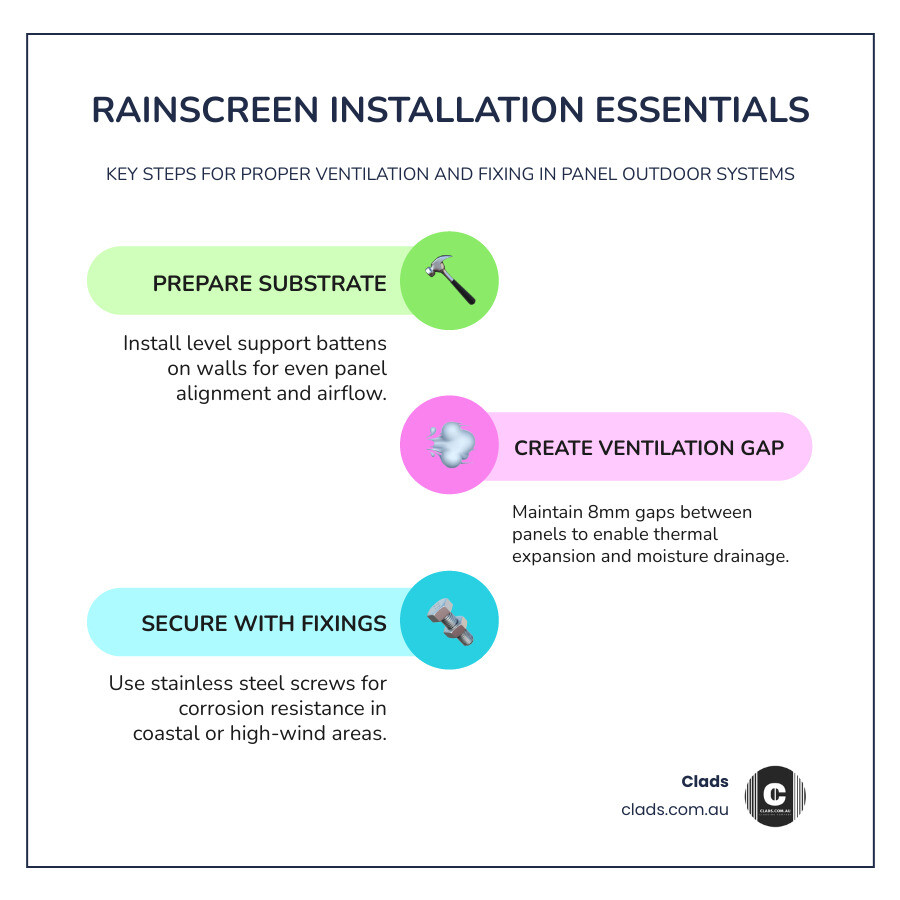
- Substrate Prep: Your wall needs to be level. If you're going over brick or uneven timber, you must install support battens (timber or aluminium).
- The Gap: Leave an 8mm ventilation gap between panels (or as specified) to allow for thermal expansion and airflow.
- Fixing: Always use stainless steel screws. For HPL or WPC, you may need to pre-drill depending on the specific system.
- Cutting: Use a standard circular saw or handsaw with a fine-tooth blade for clean edges.
- Finishing: Use matching L-corner profiles and edge banding to hide raw edges and create that "architectural" finish.
If you're looking to carry the look inside, our internal cladding solutions allow for a seamless transition from your outdoor patio right into your living room. For those who want the prestige of stone without the $200/sqm labour cost, our stone cladding options offer a manageable DIY alternative to traditional masonry.
Safety Certifications and Australian Compliance Standards
In Australia, safety isn't optional. When you're buying a panel outdoor system, you need to ensure it meets the National Construction Code (NCC).
At Clads, we take this seriously. Our products are tested against AS1530.3, which measures four key factors:
- Ignitability Index: How easily it catches fire.
- Spread of Flame Index: How fast fire moves across it.
- Heat Evolved Index: How much heat it releases.
- Smoke Developed Index: How much smoke it produces (ours typically score a low 7).
If you live in a bushfire-prone area in Western Sydney or regional Victoria, you’ll need to check the BAL (Bushfire Attack Level) rating. Many of our WPC panels are rated for BAL-29, while aluminium is the go-to for BAL-40 or BAL-FZ (Flame Zone) requirements.
With 18 years of experience and a national distribution network of 150+ depots, we ensure that whether you're in Parramatta or Perth, you're getting a product that is safe, compliant, and built to last. You can explore our full WPC cladding range online to see the specs for yourself.
Frequently Asked Questions about Panel Outdoor Solutions
What is the most durable panel outdoor material for coastal homes?
Aluminium and high-quality WPC are the winners here. Aluminium with a PVDF coating resists salt spray corrosion indefinitely, while WPC (Wood Plastic Composite) won't rot or warp in high humidity. Let's be real, traditional timber just can't keep up with the salt and sun without constant sanding and oiling.
Can I install architectural exterior panels over existing brick?
Yes, you absolutely can. Here's the thing: you need to install a batten system first. This creates the necessary ventilation gap (rainscreen) between the old brick and the new panels. It prevents moisture from getting trapped and keeps your home's thermal performance in check.
Are these panels fire-rated for high-risk bushfire areas?
Many modern panels are specifically engineered for this. You need to look for a BAL (Bushfire Attack Level) rating that matches your local council requirements. Aluminum is naturally non-combustible, while premium WPC panels often carry BAL-29 ratings, making them safe for most suburban and regional Australian builds.
Transform Your Home with Clads Performance Panels
At the end of the day, a panel outdoor system is an investment in your property’s future. It’s about moving away from the "cheap" fix that costs you thousands in maintenance and moving toward a high-performance facade that pays for itself over time.
From our roots in East and West Melbourne to our national reach across 150+ depots, Clads is built on real renovation experience. We don't just sell panels; we provide design-led solutions that we’d use on our own homes.
Whether you want the warm texture of a wood-look WPC or the sleek, industrial vibe of aluminium, we have the stock and the technical expertise to help you get it right. 2026 is the year to stop maintaining your home and start enjoying it.
Ready to start your transformation?