



Why Your Home's Exterior Finish Matters More Than You Think
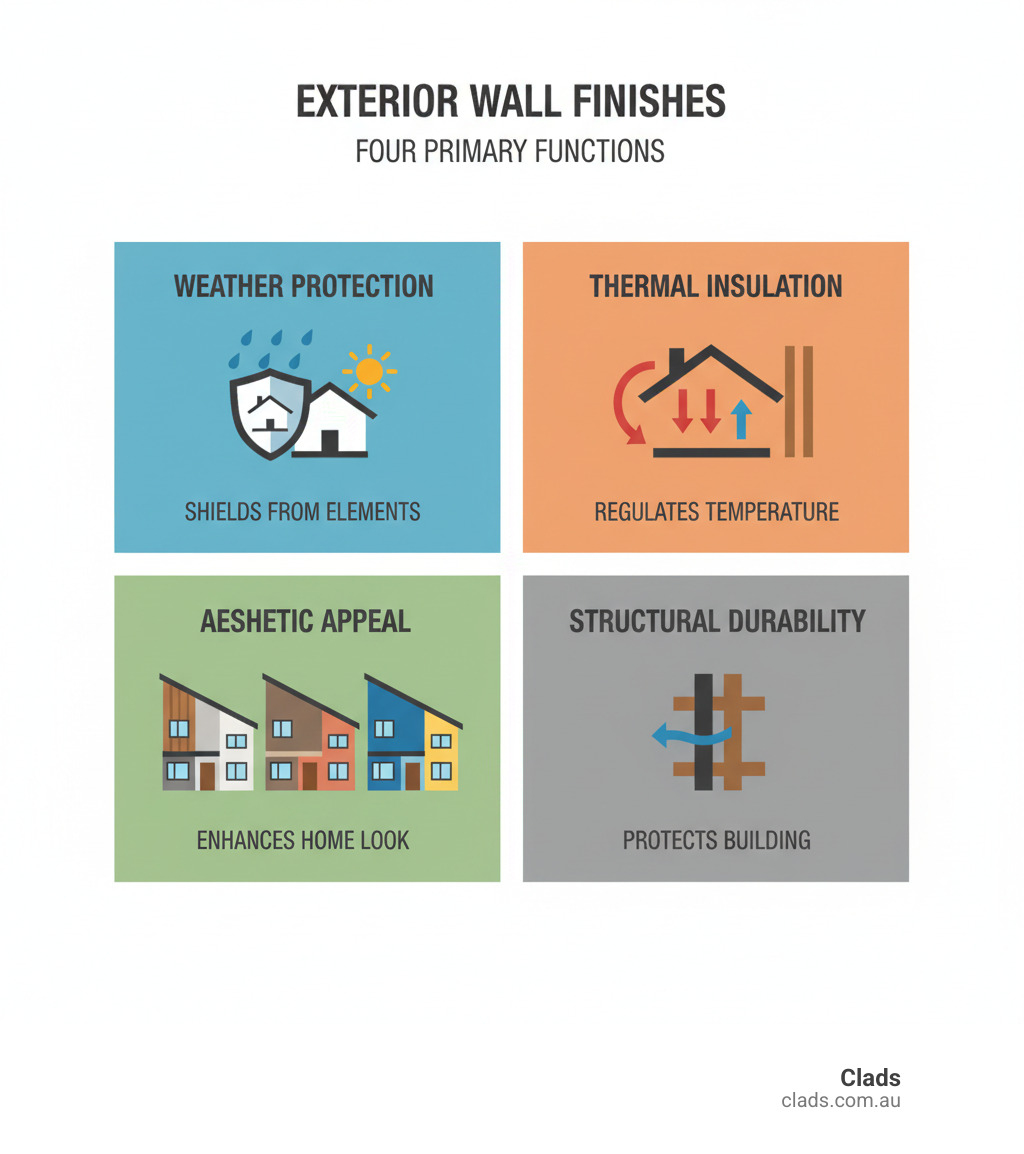
Exterior wall finishes are the protective and decorative materials that cover the outside of your home. They serve three critical functions:
- Weather Protection: Shield your home from rain, wind, UV radiation, and extreme temperatures
- Aesthetic Appeal: Define your home's character and boost curb appeal
- Thermal Performance: Improve energy efficiency by creating an insulated building envelope
- Structural Durability: Prevent moisture damage, rot, and pest infiltration
The exterior of your home is more than just its first impression. It's your property's primary defence against Australia's harsh climate, from scorching summers to coastal salt spray and bushfire threats.
Based on industry trends, an increasing number of new Australian homes are choosing modern cladding systems, moving away from high-maintenance timber towards durable, low-maintenance options like fibre cement, stone, and composite materials.
High-quality cladding materials such as fibre cement, stone, and WPC can last 50+ years with proper installation and occasional maintenance. Choosing the wrong material, or skipping maintenance, can lead to more frequent repairs, repainting, or sealing.
Whether you're renovating a tired weatherboard home or designing a new build, understanding your options is essential. Modern cladding solutions like stone, cement, and composite (WPC) offer the perfect balance of beauty and practicality.
This guide will walk you through the functional role of exterior cladding, explore the best modern materials available in Australia, and help you choose the right finish for your climate, budget, and design vision.
More Than Just a Pretty Face: The Functional Role of Exterior Cladding
Let's be honest: when you're choosing exterior wall finishes, you're probably thinking about how they'll look first. That stunning stone facade or sleek modern profile catches your eye and gets you excited about the possibilities. But here's the thing: the real magic of quality cladding happens behind the scenes.
Think of your cladding as your home's suit of armour. In Australia, that armour needs to stand up to some pretty intense challenges. We're talking scorching UV radiation that can fade and degrade lesser materials over time. Powerful coastal winds that test every fixing point. And of course, those sudden downpours that seem to come out of nowhere.
Weather protection is where modern cladding systems really earn their keep. The materials we supply at Clads Australia are designed to deflect all of this punishment while looking effortlessly stylish. But it's not just about blocking the elements at the surface level. Proper moisture management is absolutely critical to preventing water ingress, which can lead to structural damage, mould growth, and repair bills that'll make your eyes water.
This is where rainscreen systems come into play. Many of our cladding solutions incorporate a ventilated cavity behind the outer layer. If any moisture does find its way past the first line of defence, this clever design allows it to drain away harmlessly rather than sitting against your building's structure. It's like giving your home a built-in escape route for water.
Quality cladding contributes to your home's thermal performance by supporting insulation and helping maintain comfortable indoor temperatures. By contributing to an effective building envelope, quality cladding helps regulate internal temperatures naturally. Your home stays warmer when it's cold outside and cooler during those brutal summer months. Less reliance on heating and cooling means lower energy costs and a smaller carbon footprint. It's a win for your budget and the environment.
There's also the bonus of sound insulation. Certain cladding systems, especially when paired with a ventilated cavity or insulation, can help reduce external noise, making your home quieter and more comfortable.
Finally, let's touch on something that often gets overlooked: protection from pests and rot. Traditional timber cladding can be vulnerable to termites, borers, and decay over time. Cement, stone, and WPC cladding are naturally resistant to rot and common pests like termites, giving your home long-term durability when installed correctly.
A Deep Dive into Modern Exterior Wall Finishes
When it comes to selecting exterior wall finishes, you're making a decision that will define your home's appearance and performance for decades to come. It's about finding that sweet spot where stunning aesthetics meet practical durability and genuinely low maintenance.
We've spent years working with architects, builders, and homeowners across Australia, and we've seen what works and what doesn't. The good news? Modern cladding technology has evolved dramatically, giving you options that simply weren't available a generation ago. Let's explore the leading solutions we provide and what makes each one special.
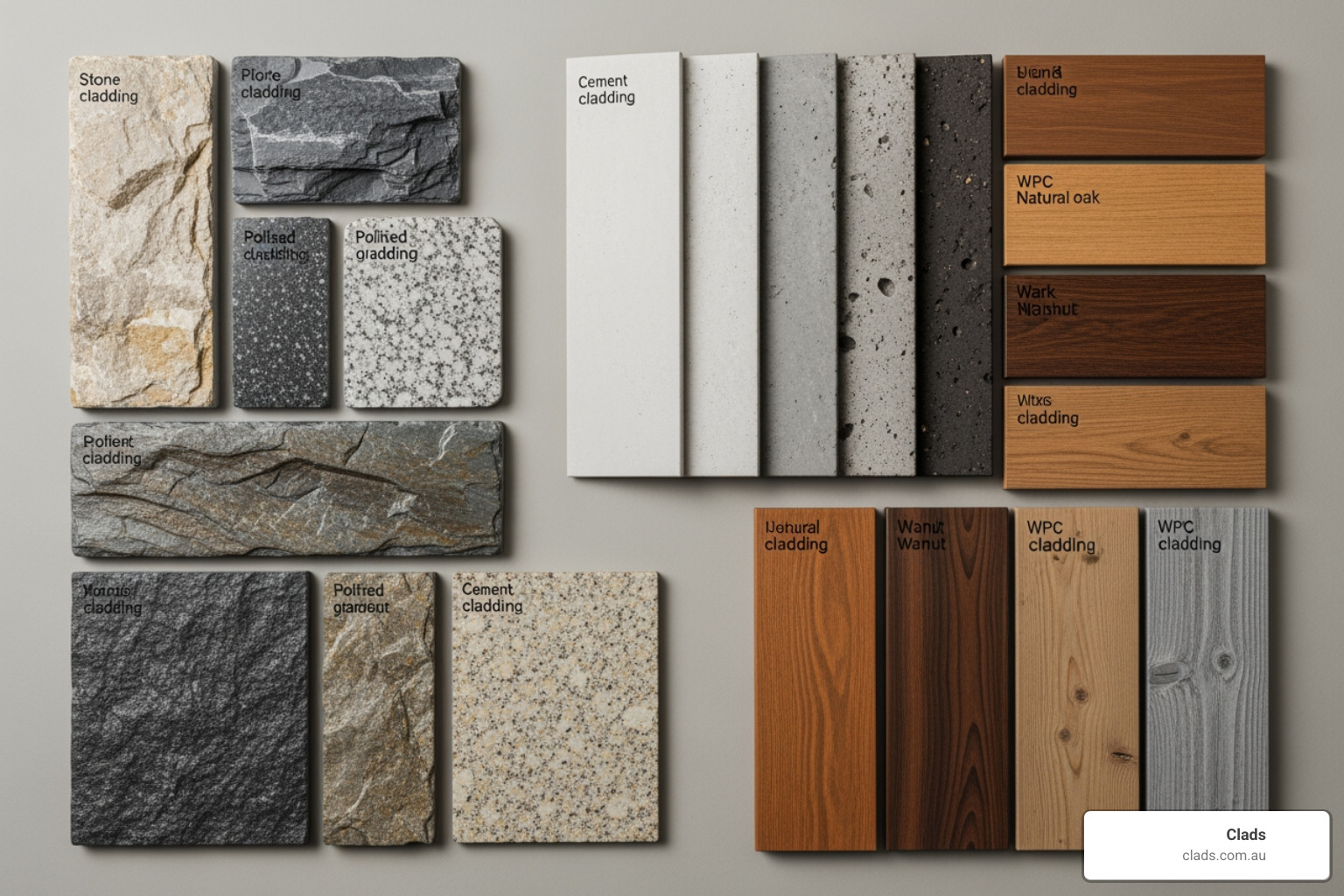
Stone Cladding: Timeless Elegance and Natural Strength
There's something undeniably special about stone. The natural variations in colour and texture mean no two installations are ever quite the same, creating that unique, luxurious look that turns heads and adds genuine prestige to any property. When architects and homeowners want to create architectural aesthetics that feel both timeless and sophisticated, stone is often their first choice.
But stone isn't just about beauty. It delivers excellent insulation properties that help regulate your home's temperature year-round, and its fire resistance is particularly valuable in bushfire-prone areas across Australia. These practical benefits make stone a smart investment, not just a pretty one.
Now, we know what you might be thinking. Traditional stone cladding has a reputation for being heavy and expensive, which can limit where and how it's used. Here's where modern innovation changes the game. While traditional stone can weigh around 80 kg/m², our lightweight stone cladding options come in at as low as 40 kg/m². You get all the aesthetic appeal and durability of natural stone, but with significantly less structural load and much simpler installation. This opens up stone as a viable option for renovation projects and designs where weight is a consideration.
The result? You can lift your faÇade effortlessly with a material that's built to last generations. The initial investment reflects the quality and longevity you're getting, and when you consider that stone requires minimal maintenance over its lifetime, the long-term value becomes clear.
Explore our premium range of stone cladding
Cement Cladding: The Versatile and Practical Choice
If versatility had a poster child in exterior wall finishes, it would be cement cladding. Also known as fibre cement, this material has become incredibly popular with builders and architects for good reason. It's that rare combination of practical performance and design flexibility.
The composition, typically wood pulp and Portland cement, gives fibre cement a unique ability to replicate the look of natural materials with surprising accuracy. Want the appearance of timber weatherboards without the maintenance? Or perhaps a stone-like texture without the weight? Cement cladding can deliver both, along with countless other styles and colours to suit any architectural vision.
What really sets cement cladding apart is its exceptional durability. It's inherently fire-resistant, making it ideal for areas with bushfire risk, and it resists rot and insect damage that would destroy traditional timber. This is cladding that delivers impact and longevity without demanding constant attention. You won't be out there every few years with paintbrushes and sealers.
For projects where you need reliable performance, design flexibility, and compliance with strict fire ratings, cement cladding ticks every box. It suits both classic and modern architectural styles equally well, which is why you'll see it on everything from heritage-style renovations to cutting-edge contemporary builds.
The trade-off? Cement cladding can be brittle, which means it requires careful handling and expert cutting during installation. Proper sealing of joints is also essential to maintain its weather resistance. But when installed correctly, it's a superior choice that will serve you well for decades.
Discover durable cement cladding options
Composite (WPC) Cladding: The Best of Both Worlds
Let's be honest. Many of us love the warm, natural look of timber but dread the maintenance that comes with it. The constant staining, sealing, checking for rot and termites, it adds up to a lot of work and expense over the years. This is where Wood Plastic Composite (WPC) cladding becomes a game-changer.
WPC combines wood fibres with recycled plastics to create a material that captures timber's aesthetic appeal while eliminating its traditional headaches. You get that inviting, natural appearance without the maintenance headache. No painting. No staining. No warping, cracking, or splintering, even under Australia's harsh sun and coastal conditions.
The durability of our WPC cladding is genuinely impressive. It resists rot, insects, and fading far better than natural timber, which means it maintains its appearance year after year with minimal effort. A simple wash down occasionally is usually all it needs. When you calculate the time and money saved on maintenance over the life of your cladding, the value proposition becomes compelling.
We've also designed our WPC systems to be lightweight and DIY-friendly. If you're an experienced homeowner who enjoys tackling projects yourself, you'll find our WPC cladding accessible and straightforward to work with. The lighter weight makes handling easier, and the installation process is more forgiving than many traditional materials.
There's also the sustainability angle. Our WPC often incorporates recycled materials, so you're making an environmentally conscious choice without compromising on quality or appearance. It's worth noting that while WPC delivers an excellent timber aesthetic, it won't have the exact same grain patterns as real wood. For most people, the trade-off for dramatically reduced maintenance is well worth it.
See our innovative external cladding solutions
Key Factors for Choosing Your Exterior Wall Finish in Australia
Selecting the perfect exterior wall finishes for your Australian home or project isn't just about picking what looks good in a catalogue. It's about understanding how different materials will perform in your specific environment, complement your design vision, and deliver value over the decades to come.
Let's start with the elephant in the room: Australia's climate. Our country throws everything at buildings, from blistering UV radiation in the outback to salt-laden coastal winds and intense bushfire threats. Your cladding needs to stand up to these conditions year after year. A material that performs beautifully in Melbourne's temperate zones might struggle in tropical Darwin or the arid interior. This is why understanding your local climate is the first step in making an informed choice.
For those in bushfire-prone areas, fire safety ratings aren't just a box to tick, they're potentially life-saving. Australia's Bushfire Attack Level (BAL) ratings dictate what materials you can legally use in certain areas. Our cement cladding offers excellent fire resistance, making it ideal for higher BAL zones. Stone cladding similarly provides exceptional fire protection. When you're choosing cladding, always confirm it meets the required BAL rating for your specific location.
Your home's architectural style should guide your material selection. Are you creating a sleek, contemporary statement with clean lines and bold textures? Or perhaps you're renovating a classic home that needs sympathetic materials? The texture, colour, and profile of your chosen exterior wall finishes will define your home's entire character. We've designed our range to support diverse architectural visions, from traditional elegance to cutting-edge modern design. Creating architectural aesthetics that truly reflect your personality is what we're passionate about.
Now, let's talk money, but intelligently. Budget versus lifecycle cost is where many people make costly mistakes. Yes, that cheaper option might save you a few thousand dollars today. But if it needs repainting every three years, constant sealing, or replacement in a decade, you'll end up paying far more over time. Our stone, cement, and WPC cladding options represent smart investments because they deliver style without the maintenance headache. Think of it as choosing between capital expenditure (CapEx) and operational expenditure (OpEx). Sometimes spending more upfront means spending far less overall.
Speaking of maintenance, how much time do you want to spend looking after your exterior walls? If the answer is "as little as possible," you're in good company. Our WPC cladding requires virtually no maintenance beyond an occasional wash. Cement cladding similarly offers a low-maintenance solution that won't demand your weekends. Compare this to traditional timber, which needs regular attention, and the value proposition becomes crystal clear.
Finally, let's consider the environmental impact. The building façade can contribute up to 15% of a commercial building's upfront embodied carbon. If sustainability matters to you (and it should), selecting materials with a lower ecological footprint makes a genuine difference. Our WPC cladding incorporates recycled materials, turning waste into beautiful, durable facades. Cement cladding also offers environmental advantages over more carbon-intensive alternatives.
Here's how our key cladding types compare across the metrics that matter most:
| Material | Initial Cost (Indicative) | Durability | Maintenance Level | Fire Resistance (General) |
|---|---|---|---|---|
| Stone Cladding | High | Very High | Low | Excellent |
| Cement Cladding | Medium-High | High | Low | Excellent |
| WPC Cladding | Medium | High | Very Low | Good (varies by product) |
The right choice balances all these factors to create a solution that works for your specific project. Whether you're drawn to the timeless prestige of stone cladding, the versatile practicality of cement cladding, or the modern efficiency of WPC external cladding, we're here to help you lift your façade effortlessly.
From Plan to Panel: Installation Best Practices
Proper installation is just as crucial as selecting high-quality exterior wall finishes to ensure longevity and performance. Even the best materials can fail if not installed correctly, which is why we're passionate about sharing best practices that prevent common issues and maximise the lifespan of your cladding.
The foundation of any successful cladding project starts with thorough substrate preparation. Think of it as preparing a canvas before painting. The wall surface needs to be clean, dry, and structurally sound. Any existing damage, rot, or moisture issues must be addressed before a single panel goes up. Skipping this step is like building a house on sand, it might look good initially, but problems will emerge down the track.
One of the most critical elements for optimal performance, especially in our diverse Australian climate, is incorporating a proper rainscreen cavity. This might sound technical, but it's actually quite simple. It's a ventilated space between your cladding and the structural wall that allows for drainage and airflow. This clever design prevents moisture build-up and promotes drying, which in turn deters mould and extends the life of your entire wall system. It's essentially giving your walls room to breathe.
Proper ventilation and drainage within this cavity work hand in hand. Weep holes positioned at the base of the cladding system allow any trapped moisture to escape rather than sitting and causing damage. Think of them as tiny emergency exits for water that somehow makes it past the outer layer.
When it comes to correct fixing techniques, using the appropriate fasteners and following manufacturer guidelines isn't just a suggestion, it's essential for structural integrity and wind resistance. Different materials require different fixing methods, and getting this right ensures your cladding stays put even during severe weather events. Additionally, meticulous sealing of joints and openings, particularly around windows and doors, creates a watertight envelope that prevents water penetration.
While some of our lightweight WPC systems are designed with DIY-friendly installation in mind for experienced homeowners who enjoy tackling projects themselves, other materials like certain stone or cement cladding applications may require professional expertise. There's no shame in calling in the pros. Understanding the nuances of each material's installation process ensures that your cladding delivers impact and longevity for decades to come.
We supply the products and can connect you with experienced installers if needed. Getting the installation right means your beautiful new cladding will protect and improve your home for years without the maintenance headache.
Don't forget the right accessories for a perfect finish
Frequently Asked Questions about Exterior Wall Finishes
When we chat with architects, builders, and homeowners about exterior wall finishes, certain questions come up time and again. We've gathered the most common ones here, along with our honest, straightforward answers based on years of experience in the cladding industry.
What is the difference between cladding and siding?
You'll hear both terms thrown around, and honestly, in Australia, they're pretty much interchangeable. We tend to use "cladding" as the broader, go-to term for any material applied to a building's exterior to create that protective and decorative skin. "Siding" is a bit more specific, traditionally referring to those overlapping horizontal boards you might picture on classic weatherboard homes, a term that gained traction in North America. Whether we're talking about stone panels, cement boards, or WPC profiles, we simply call it all cladding. It keeps things simple.
Which exterior wall finish is the most low-maintenance?
If you're after a truly set-and-forget option for your exterior wall finishes, our composite WPC cladding is hard to beat. It doesn't need painting, staining, or sealing, ever. It naturally resists rot, pests, and fading, which means you can spend your weekends doing something far more enjoyable than maintaining your walls. Cement cladding runs a close second, offering exceptional durability and resistance to the elements without demanding constant attention. Both options free you from the endless cycle of upkeep that comes with traditional timber, giving you style without the maintenance headache.
Can I install exterior cladding myself?
Absolutely, if you're handy and have some experience with building projects. Our lightweight WPC cladding systems are specifically designed to be DIY-friendly, with straightforward installation processes that experienced homeowners can confidently tackle. We've seen plenty of successful DIY installations that look fantastic. That said, if you're working with heavier materials like some of our stone or cement panels, or if the project involves complex details, bringing in a professional installer is the smarter move. They'll ensure everything is done to code, properly sealed, and built to last. We don't install cladding ourselves, but we're always happy to connect you with trusted installers in your area.
How do exterior wall finishes improve energy efficiency?
This is where exterior wall finishes really prove their worth beyond just looking good. They create a thermal break that reduces heat transfer between your home's interior and the outside world. Many of our cladding systems, particularly those incorporating a rainscreen cavity, create an insulated air gap that acts as an additional buffer. Materials like stone and cement also have natural insulative properties that help keep your home cooler in summer and warmer in winter. The result? Your heating and cooling systems don't have to work as hard, which translates directly into lower energy bills and a smaller carbon footprint. It's one of those rare win-win situations.
What are the latest trends in exterior finishes?
The design world is embracing texture and depth in exciting ways right now. We're seeing a strong shift towards textured profiles, particularly castellated and batten cladding, which create beautiful shadow lines that change throughout the day as the sun moves. These profiles add a dynamic, three-dimensional quality to facades that flat surfaces simply can't match. Another trend that's really taking off is mixing different materials on a single building. Think stone cladding combined with WPC or cement panels to create visual contrast and highlight specific architectural features. This approach lets you design the difference and create truly unique architectural aesthetics that stand out from the cookie-cutter designs you see everywhere else. It's about creating facades that tell a story and reflect individual style.
Design the Difference with the Right Finish
Your home's exterior is its first handshake with the world, and choosing the right exterior wall finishes is one of the most important decisions you'll make. It's not just about creating a stunning façade (though that's certainly part of the magic). It's about protecting your investment from the harsh Australian elements, improving energy efficiency, and adding lasting value to your property.
Throughout this guide, we've explored how modern cladding solutions do far more than look good. They shield your home from UV radiation, wind, and moisture. They contribute to thermal performance and energy savings. And when you choose quality materials like our stone, cement, and composite (WPC) options, they deliver decades of reliable performance with minimal fuss.
The beauty of working with Clads Australia is that you're partnering with specialists who genuinely understand the intersection of design and practicality. We don't just sell cladding products. We help architects, builders, and design-conscious homeowners create architectural aesthetics that stand out and stand the test of time. Whether you're drawn to the timeless elegance of stone, the versatility of cement, or the low-maintenance appeal of WPC, we have solutions that deliver impact and longevity.
We believe in making quality accessible. That's why we've built a network of 150 depots across Australia, ensuring that superior cladding solutions are within reach no matter where your project is located. And because we know that seeing and touching a product makes all the difference, we encourage you to experience the quality for yourself.
Ready to lift your façade effortlessly? We Create Aesthetics. Design the Difference.
Get in touch with our design-led cladding specialists today, or order a free sample to experience the quality firsthand.