



What Makes Wood Plastic Composite a Game-Changer for Modern Homes
Wood plastic composite is revolutionising how Australians approach exterior and interior cladding. For those searching for a durable, low-maintenance alternative to traditional timber, WPC offers a compelling solution.
Quick Answer:
- What it is: A composite material made from recycled wood fibres (30-65%) and thermoplastic polymers.
- Key benefits: Superior resistance to rot, moisture, and insects with minimal maintenance.
- Main uses: External and internal cladding, feature walls, and decorative screening.
- Lifespan: 15-25+ years, significantly outlasting traditional timber.
- Maintenance: Periodic cleaning only; no painting, staining, or sealing needed.
For busy homeowners tired of constantly maintaining weathered timber, wood plastic composite combines the natural aesthetic of wood with the durability of modern engineered materials. This blend delivers long-term value, with a payback period of just 3 to 5 years thanks to dramatically reduced maintenance costs compared to pressure-treated timber.
At Clads Australia, we specialise in helping builders and homeowners find the right WPC solutions to transform their projects with superior performance and lasting aesthetic appeal.
What is Wood Plastic Composite? A Modern Building Solution
Wood plastic composite is an innovative building material that blends natural wood elements with plastic polymers. First patented in the 1960s, WPC entered the mainstream in the 1990s, primarily for decking, and its use has grown remarkably since.
Technically, wood plastic composites (WPCs) are a type of natural fibre plastic composite (NFPC). They harness the best qualities of both worlds: the natural look of wood and the durability and weather resistance of plastic. Our range of WPC cladding at Clads Australia embodies this blend, offering solutions that are both beautiful and exceptionally durable for the Australian climate.
The Core Materials of Wood Plastic Composite
Understanding WPC's composition explains its high performance. It's a product of thoughtful material science.
- Wood Component (30-65%): This comes from recycled sources like sawdust, wood flour, and wood fibres. The wood must be dried to a very low moisture content (around 0.5%) to ensure a stable bond with the plastic.
- Thermoplastic Component: This gives WPC its weather resistance. Common plastics include polyethylene (PE), polypropylene (PP), and polyvinyl chloride (PVC). Many WPCs use recycled plastics, improving their sustainability profile.
- Additives: These fine-tune performance. Colourants provide a wide range of tones. UV stabilisers protect against sun degradation, crucial in Australia. Coupling agents create a strong bond between the water-attracting wood fibres and water-repelling plastic, improving strength and stability. Lubricants and other agents aid the manufacturing process.
By combining these materials, we create a composite that offers superior performance and longevity compared to traditional timber.
How WPC is Made: From Raw Material to Finished Board
The manufacturing of wood plastic composite transforms recycled materials into durable building products.
The process begins with compounding, where dried wood particles, heated thermoplastic resin, and additives are thoroughly mixed into a dough-like consistency. This ensures a homogeneous blend.
Next is the forming process. Extrusion is the most common method, where the molten composite is forced through a die to create continuous profiles like decking or cladding boards. For more complex parts, injection moulding is used, where the material is injected into a mould. Because WPC starts as a paste, it can be moulded into almost any shape, including arched or bent shapes, opening up vast design possibilities.
Finally, the profiles are cooled and finished by cutting, sanding, or embossing to achieve the desired texture and dimensions. Our WPC cladding at Clads Australia benefits from these advanced techniques, ensuring consistent quality and a superior finish.
Key Properties and Performance of Wood Plastic Composite
The beauty of wood plastic composite lies in how it combines the natural warmth of timber with the resilience of modern engineering.
Workability and Design Flexibility
One of WPC's best features is its versatility. It can be shaped, drilled, and sanded using conventional woodworking tools, making installation straightforward. Because WPC starts as a paste during manufacturing, it can be moulded into almost any shape, from standard profiles to complex arched or bent shapes. The material can also be custom-coloured during production, giving architects and designers immense creative freedom.
Understanding the Durability of Wood Plastic Composite
What truly sets wood plastic composite apart is its exceptional durability, which is essential in Australia's harsh climate.
- Moisture and Weather Resistance: Unlike natural wood, WPC is engineered to resist moisture absorption. The plastic encapsulation protects the wood fibres, preventing the swelling, warping, and cracking common with timber. This makes WPC highly resistant to rot, decay, and even marine borer attack.
- Dimensional Stability: Thanks to coupling agents, WPC exhibits excellent dimensional stability, meaning it won't expand or contract dramatically with temperature and humidity changes.
- The Low-Maintenance Advantage: WPC requires no painting, staining, or sealing. A periodic clean is all that's needed, saving significant time and money over the product's lifespan.
Here's a practical comparison of wood plastic composite and traditional timber:
| Metric | Wood Plastic Composite (WPC) | Traditional Timber (e.g., pressure-treated pine) |
|---|---|---|
| Maintenance | Very low; periodic cleaning only; no painting/staining | High; regular painting, staining, sealing required to prevent decay |
| Rot Resistance | High; highly resistant to rot, decay, and marine borers | Low to moderate (unless chemically treated); susceptible to rot |
| Lifespan | Long; 15-25+ years (often with warranties) | Shorter; 10-15 years, highly dependent on maintenance and conditions |
| Initial Cost | Higher (approx. 15% more than pressure-treated lumber) | Lower |
| Colour Fade | Can fade over time due to UV exposure; stabilisers mitigate | Fades, greys, and weathers significantly over time |
| Workability | Can be cut, drilled, sanded with conventional tools; better fastener hold | Can be cut, drilled, sanded; prone to splitting near ends |
Technical Characteristics and Performance Data
At Clads Australia, we believe in transparency about WPC's technical realities to help you make informed decisions.
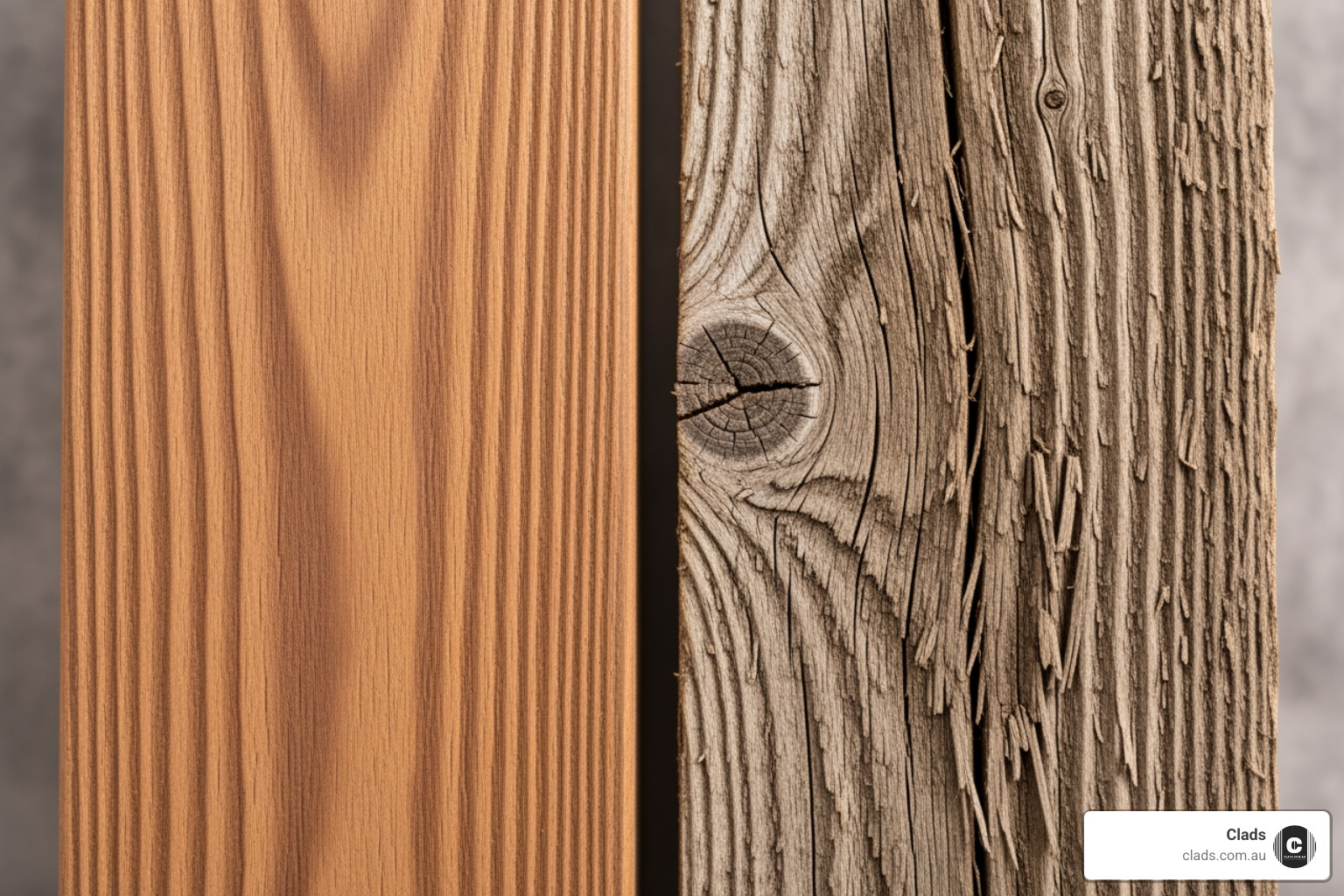
- Mechanical Properties: WPC generally has lower strength and stiffness than solid wood. It is best suited for non-structural applications like cladding and decorative features, not load-bearing elements. The material can experience "creep" (gradual deformation under load) over time.
- Thermal Expansion: WPC expands and contracts with temperature changes. This must be accounted for during installation with appropriate spacing to prevent buckling. Our team can provide detailed guidance.
- Fire Performance: The thermoplastics in WPC have higher fire hazard properties than wood alone. This is an important consideration in areas with strict fire codes or bushfire-prone regions. We ensure our products meet relevant Australian standards and can discuss fire ratings for your location when you contact our team.
- UV Resistance: While our WPC products contain UV stabilisers, some colour fading over time with prolonged sun exposure is realistic. However, WPC maintains its structural integrity and doesn't require re-staining. A periodic clean helps maintain its appearance.
Applications and Advantages: Why WPC Outshines Traditional Timber
Wood plastic composite is often the smarter long-term investment for Australian homes. While WPC typically costs about 15% more upfront than pressure-treated timber, this premium is quickly recovered. The payback period is just 3 to 5 years, thanks to the elimination of maintenance costs like painting, staining, and treating. For busy homeowners, this means genuine style without the maintenance headache.
This cost-effectiveness stems from WPC's superior durability. It is engineered to resist moisture, rot, and insects, ensuring your investment maintains its integrity and appearance for decades. While our focus is on external performance, we also offer complementary solutions like our timber indoor cladding options to create visual harmony throughout your property.
Common Uses for WPC in Construction
The versatility of wood plastic composite is changing how Australians approach building design.
- External Cladding and Siding: Our specialty at Clads Australia. WPC cladding can lift your facade effortlessly while delivering long-term performance. You can explore our WPC cladding options to see the available profiles and finishes.
- Internal Feature Walls: WPC is not just for outdoors. It can be used to create stunning, low-maintenance feature walls inside the home, adding texture and warmth.
- Decorative Screening and Soffits: The versatility of WPC makes it ideal for creating architectural screens, privacy barriers, or finishing soffits with a consistent, durable material.
- Acoustic Panelling: Some interior WPC profiles can be paired with acoustic backings to improve sound quality within a room, combining aesthetics with function.
WPC for External and Internal Cladding
For architects, builders, and homeowners, wood plastic composite cladding represents the perfect marriage of aesthetic ambition and practical performance.
Modern WPC cladding has evolved far beyond early artificial-looking composites. The ranges at Clads Australia feature sophisticated colours and finishes that capture timber's natural beauty. Our textured profiles, including batten and castellated designs, create stunning depth and shadow lines, creating architectural aesthetics that make a project stand out. For more inspiration, see our guide to all about outside wall cladding options.
Crucially, WPC is engineered to handle Australian conditions, from temperature extremes to coastal humidity and relentless UV exposure. It's a smart choice when considering your home's best dress and exterior wall finishes. While WPC excels externally, it can also be used in certain interior spaces. For a comprehensive design, consider pairing it with our range of acoustic panels to improve both visual appeal and sound quality.
Limitations and Important Considerations
Like any material, wood plastic composite has characteristics to understand before choosing it for your project. Our goal at Clads Australia is to ensure you select the right material for your needs.
- Weight: WPC is denser and heavier than timber, which should be factored into handling and transport planning.
- Structural Use: WPC is not designed for primary structural loads like beams. It is best used as a protective and decorative skin for a building.
- Heat: Darker colours can get hot in direct sun. For surfaces exposed to direct sun, lighter colours may be more comfortable to the touch in summer.
- Staining: The surface is slightly porous and can be stained by grease or oil if not cleaned promptly. Quick clean-ups will prevent permanent marks.
Sustainability and Environmental Impact
The environmental story of wood plastic composite is nuanced, with significant positive aspects.
The main benefit is that WPC diverts waste from landfills by using recycled wood fibres and plastics (like HDPE, PP, and PVC). Some products are made entirely from recycled content and can be recycled again.
However, there are complexities. Post-consumer recycling of WPC can be difficult and costly due to the mixed materials. Also, because it contains petroleum-based polymers, WPC is not biodegradable. The manufacturing process also requires energy. Despite this, many choose WPC as a practical middle ground: a durable, long-lasting material that actively uses waste streams and reduces the need for replacement materials over its long lifespan.
Installation and Maintenance
Wood plastic composite shines in its ease of installation and maintenance, making it ideal for Australian homeowners and builders.
Many of our WPC cladding systems are designed for DIY installation. It can be cut, drilled, and fastened using conventional woodworking tools. However, proper installation is crucial. WPC expands and contracts with temperature, so accounting for this thermal movement with correct spacing and fasteners is essential for long-term performance. Our team at Clads Australia is always available to provide guidance.
To achieve a professional finish, use our comprehensive range of cladding accessories. For larger projects, professional installation may be best. While we only supply the products, we can help you find experienced local installers upon request.
The best part is the minimal maintenance. Forget annual painting, staining, or sealing. A periodic clean with soap and water, or a pressure washer for tougher dirt, is all that's needed. This low-maintenance approach saves significant time and money, making WPC a smart choice for busy Australian lifestyles.
Frequently Asked Questions About WPC
Is wood plastic composite better than real wood?
WPC offers distinct advantages over real wood, particularly in terms of maintenance and durability. It provides superior resistance to rot, moisture, insects, and splinters, requiring significantly less upkeep (no painting, staining, or sealing). Real wood, while having higher structural strength and a lower initial cost, demands regular maintenance to prevent decay, warping, and weathering. For applications like cladding, where low maintenance and longevity in harsh Australian conditions are priorities, WPC often proves to be the "better" choice.
Does WPC look fake?
Early generations of WPC could sometimes look artificial, but modern, high-quality WPC products from Clads Australia have come a long way. Our ranges feature realistic wood grain textures, deep, consistent colours, and sophisticated finishes that closely mimic the natural aesthetic of timber. With advancements in manufacturing, it's now possible to achieve a premium look that improves architectural aesthetics without the maintenance drawbacks of natural wood.
How long does wood plastic composite last?
WPC is engineered for exceptional durability and longevity. Many WPC products are designed to last for decades, with manufacturers often offering warranties of 15-25 years or even more. With minimal and proper maintenance, WPC can significantly outlast traditional timber cladding, providing long-term value and peace of mind for your Australian home.
Can you paint or stain WPC?
While WPC comes in a variety of pre-finished colours and is designed to maintain its appearance, painting or staining is generally not recommended. The composite nature of WPC means paint may not adhere properly, can peel, or may void the product's warranty. WPC is intended to be a low-maintenance material that doesn't require these surface treatments, allowing you to enjoy its aesthetic without the hassle.
Is WPC environmentally friendly?
WPC is considered a sustainable choice due to its primary composition of recycled wood fibres and recycled plastics, which diverts waste from landfills. However, its environmental profile is nuanced. While it reduces waste, WPC itself is not biodegradable due to its plastic content. Its end-of-life recycling can also be complex due to the mixed materials. For projects prioritising long-term durability and minimal resource consumption through reduced maintenance over a product's lifespan, WPC offers a compelling, more environmentally conscious alternative to virgin timber that requires constant treatment.
Design the Difference with WPC
Wood plastic composite has transformed the way Australians approach cladding, offering a smart blend of natural timber aesthetics with the performance and durability of modern engineered materials. Throughout this guide, we've explored how WPC stands out for its exceptional resistance to rot, moisture, and pests, all while requiring minimal maintenance. Its design flexibility allows for custom colours, realistic wood grain textures, and even complex shapes like curves and arches, making it a versatile choice for both external and internal applications.
For homeowners and builders tired of the constant upkeep that traditional timber demands, WPC provides a refreshing alternative. No more weekends spent painting, staining, or sealing. Just periodic cleaning to keep your facade looking sharp. And with warranties often extending 15 to 25 years or beyond, you're investing in a material that's built to last through Australia's harsh UV, coastal humidity, and temperature extremes.
At Clads Australia, we're the cladding specialists who live and breathe creating architectural aesthetics that endure. Our curated range of high-quality, design-led WPC cladding solutions is carefully selected for aesthetic impact, long-term durability, and suitability for the Australian climate. Whether you're an experienced DIY enthusiast looking for a weekend project or a professional builder seeking reliable, stylish materials, our products deliver the performance and visual appeal your project deserves. We're passionate about cladding that delivers impact and longevity, and we're here to support you every step of the way.
Based in Sunshine, Victoria, we understand the unique challenges Australian homes face. Our WPC solutions are designed to handle everything from scorching summer sun to coastal conditions, ensuring your investment looks stunning and performs flawlessly for decades. We sell the products and provide the expertise, and if you need installation support, we can help you find experienced local installers in your area upon request.
Ready to transform your home with the lasting benefits of wood plastic composite? Design the Difference with Clads Australia.
Request your free samples to see the quality firsthand – there's nothing quite like seeing and feeling the texture and colour in your own home's lighting.
Contact our expert team to discuss your project needs – we're here to help you find the perfect WPC cladding solution for your vision.
We Create Aesthetics. Let's lift your facade effortlessly, with style and without the maintenance headache.