



Your First Step to a Flawless Facade
How to install WPC cladding is simpler than you might think. Here's your quick-start checklist:
- Prepare your surface - Clean, dry, and level the wall, then apply a waterproof membrane.
- Install battens - Fix support battens at 500mm spacing (or 400mm in high-wind areas).
- Start with the first board - Use starter clips 8mm from the floor and ensure perfect alignment with a spirit level.
- Interlock and secure - Slot in subsequent panels and pre-drill holes before screwing into battens.
- Finish professionally - Trim around corners and windows, leaving expansion gaps.
WPC (Wood Plastic Composite) cladding combines the natural beauty of timber with the durability of composite materials. It's rot-resistant, low-maintenance, and an achievable DIY project that can transform your home's exterior.
Unlike traditional timber, WPC cladding maintains its look with just an occasional rinse. It reaches its final, stable colour within the first six months and lasts for 15-25 years with proper installation.
I'm James Lawrence. With 15 years in Melbourne's construction sector, I've guided many clients through WPC cladding projects. At Clads Australia, we supply premium materials and can connect you with trusted local installers when needed.
Handy how to install WPC cladding terms:
The Ultimate Guide on How to Install WPC Cladding
WPC wall panels blend wood's aesthetic with plastic's resilience, making them durable, attractive, and easy to install. Understanding how to install WPC cladding is the first step to changing your home or commercial space.
Made from a mix of wood fibre, polymers, and performance-enhancing additives, WPC cladding offers UV protection and colour stability. It resists moisture, mould, and mildew, making it a durable, low-maintenance choice for any Australian property.
1. Preparation: Tools, Materials, and Wall Assessment
Thorough preparation is key to a successful installation. Before you begin, gather your tools and materials.

Tools:
- Tape measure
- Spirit level
- Fine-tooth saw (circular or mitre)
- Drill/driver with bits
- Rubber mallet
- Safety goggles and work gloves
- String line
Materials:
- WPC cladding panels
- Battens (composite or treated timber)
- Starter clips
- Corrosion-resistant screws (stainless steel is best)
- Corner trims and fascia boards
- Waterproof membrane
- Construction adhesive (optional)
Your wall surface must be clean, dry, and flat. Repair any damage before you begin. Applying a waterproof membrane is a critical step to protect the underlying structure from moisture.
To calculate materials, measure the total area and add 10-15% for wastage from cuts. This avoids mid-project shortages. For more insights, check out our guide on Transform Your Space: Everything You Need to Know About WPC Wall Panels. We also offer a comprehensive range of accessories.
2. Building the Framework: Installing Battens Correctly
Battens are the backbone of your cladding system, providing support and crucial ventilation.
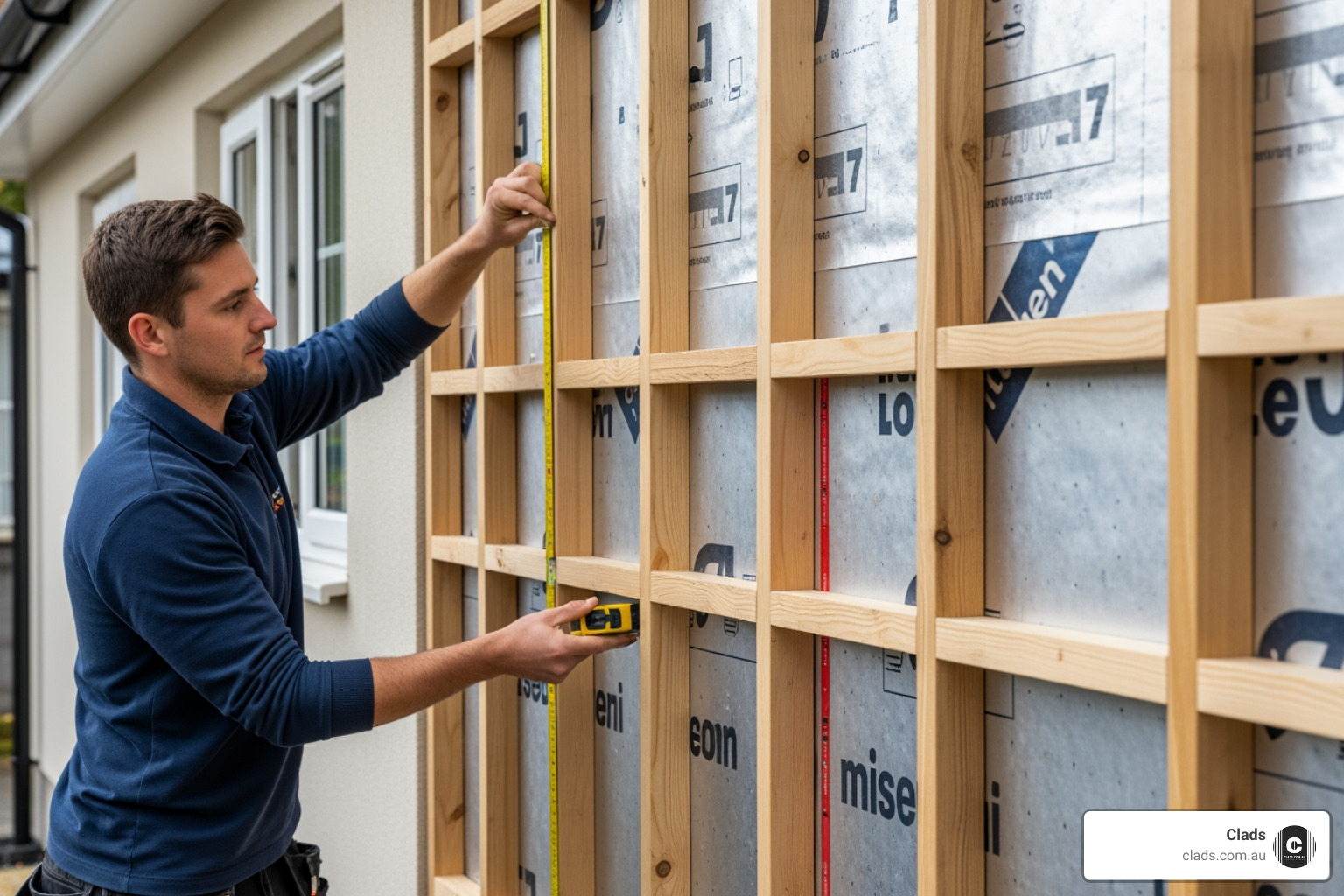
We recommend composite battens for superior durability in the Australian climate. Typical batten dimensions are 50mm x 30mm, which creates a vital air gap for ventilation and moisture management.
For structural integrity, space battens a maximum of 500mm apart. In high-wind areas, reduce this to 400mm. Batten orientation must be perpendicular to your cladding boards (e.g., vertical battens for horizontal cladding).
Secure battens to a flat, stable surface. Pre-drill holes and use corrosion-resistant screws to fix them to the wall. Use a spirit level to ensure all battens are perfectly straight. Learn more in our article on Beyond Wood: Discovering the Benefits of Wood Plastic Composite.
3. How to Install WPC Cladding: The Step-by-Step Process
Now you can begin installing the cladding. First, unpack your WPC boards and let them acclimatise on a flat surface for at least 48 hours to prevent warping.
Starter clips are crucial for the first row. Attach them to the battens 8mm from the floor to create a vital gap for drainage and expansion.
Aligning the first board is the most critical step. Place it on the starter clips and use a spirit level to ensure it's perfectly straight. Any error here will be magnified on subsequent boards.
The interlocking tongue-and-groove system makes installation straightforward. Slot the next panel into the groove of the previous one, using a rubber mallet to gently tap it into place.
When securing panels, pre-drill screw holes one size larger than your screws to allow for natural expansion. Use screws at least 20mm long to secure panels to every batten, but do not over-tighten them.
Expansion gaps are essential. Leave a 5-6mm gap between panels and around all edges (corners, windows, doors) to allow for natural expansion and contraction. Ready to explore? View our WPC Cladding range.
4. Finishing Touches: Corners, Windows, and Trims
Professional results are in the details. Neat corners, windows, and trims lift the final look.
When cutting panels, use a fine-tooth saw for a clean edge. To prevent chipping with a circular saw, cut with the decorative side facing down.
For window reveals and door frames, cut boards to fit precisely. Use L-corner trims to protect edges and create a clean, finished line.
Corner trims protect exposed edges and provide a neat finish. Attach them with exterior-grade adhesive. Mitre corner joints at 45 degrees for a seamless look. Fascia boards can cover expansion gaps for a polished appearance. Explore our full range of External Cladding options to inspire your next project.
5. Troubleshooting and Maintenance for Long-Lasting Results
Knowing how to avoid common mistakes and perform simple maintenance will keep your WPC cladding looking great for decades.
Common Mistakes to Avoid:
- Skipping wall prep, cleaning, or the waterproof membrane.
- Incorrect batten or expansion gap spacing, leading to sagging or buckling.
- Over-tightening screws, which can crack the boards.
- Inaccurate measurements cause waste and a poor fit.
- Misaligning the first panel.
Troubleshooting:
- Gaps: Small gaps can sometimes be closed with a rubber mallet. Use matching caulk for larger gaps.
- Warping: This is usually caused by insufficient expansion gaps or moisture. Check for proper airflow and adequate gaps.
Maintenance Routine: WPC cladding is very low-maintenance, requiring no sanding or painting.
- Routine Cleaning: A simple rinse with water is usually enough.
- Tougher Spots: Use a mild detergent and a soft brush, rinsing thoroughly.
- Pressure Washer: You can use a pressure washer below 2,000 psi with a fan tip, keeping it 250-300mm from the surface. Test on a hidden area first.
WPC Lifespan and Fire Rating: WPC cladding has a lifespan of 15-25 years. It is generally not fire-rated, so if fire resistance is critical, consult your local council. WPC panels are also great for interiors; learn more in our guide: Clad It Up: Mastering Internal WPC Panel Installation.
6. Key Considerations for Your WPC Cladding Project
Beyond installation, consider where you can use WPC and local regulations.
Indoor Installation: WPC cladding is also great for indoor use. Its moisture resistance makes it ideal for bathrooms and kitchens. Use it for striking feature walls, durable surfaces, or even for ceiling lining. For more on overhead designs, check out Give Your Ceiling a Glow Up: Fitting Internal Cladding Made Easy. Our Internal Cladding range offers many design possibilities.
Planning Permission: In Australia, replacing existing cladding generally doesn't require planning permission. However, exceptions apply for listed properties or if the new material significantly changes the home's appearance. Always check with your local council in Victoria. Clads Australia supplies materials only and cannot provide planning advice.
Climate Considerations: WPC performs well in Victoria's varied climate, but remember to:
- Acclimatise panels for 48 hours before installation.
- In high-wind areas, reduce batten spacing to 400mm.
- Follow manufacturer guidelines for installation in extreme temperatures.
Colour Stabilisation: WPC cladding undergoes a normal, slight weathering process in the first six months, after which the colour stabilises for its entire lifespan.
Final Thoughts and Your Next Steps
We hope this guide on how to install WPC cladding has been helpful. Installing WPC is an achievable DIY project that offers long-term value, durability, and a stunning aesthetic.
At Clads Australia, we supply high-quality, low-maintenance WPC cladding to help you achieve "Creating Architectural Aesthetics." Our products are chosen for their performance and longevity in the Australian climate.
Ready to "Design the Difference"? Our team is here to support you. While we don't install cladding, we can connect you with a trusted local installer in Victoria to bring your vision to life. For visual guides and inspiration, check out our official YouTube channel. For expert advice or to discuss your project, get in touch with our friendly team.